Corporate Lifecycle
Throughout this website, references to start-up and seed-stage companies occur frequently. A simple web search for corporate lifecycle returns many perspectives and opinions. PrimeAxcess defines the stages of a company's evolution from inception to maturity into eight phases:
Seed
A genuine seed-stage company has not yet usually established commercial operations, and may be a company involved in continued research and product development. These early companies are typically quite difficult business opportunities to finance - often requiring capital for pre-startup R& D, product development and testing, and/or designing specialized equipment.
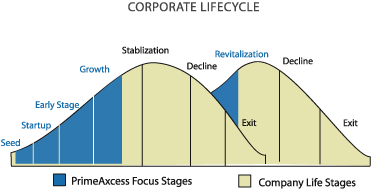
Start-up
The period between seed financing and the first sale. Most software product companies start with an entrepreneur and a vision. They see a market opportunity and know how to exploit technology to satisfy it. They need to assemble a small executive team around them with the necessary skills as they start to build the product. This may require additional people to be recruited into development, but cash is usually in short supply.
The entrepreneurial leaders are often skilled engineers and the early releases of product seems to spring from their visionary minds directly into program code. The whole company typically sits in the same room. Communication is rapid, commitment and energy are high. Unless care is taken, working practices are established which cannot scale to a larger organization, and are hard to change.
Early Stage
This phase begins when the first customer takes delivery of the product. It ends when the product is stable enough to be commissioned for a new customer without causing any overhead on product development. The product has been shipped to a number of customers. Each has a list of features that they insist must be added. Every new sale seems to require extensions to the product. At the same time, the base product may not yet be reliable.
By now the entrepreneur typically needs more cash and must approach external investors. Unresolved issues from the startup phase will have a growing impact on the company, and become harder to deal with. At the same time, new issues can emerge.
Growth (Expansion)
This phase begins when the product or service are widely available generating ongoing revenue and can be commissioned for a new customer without creating any overhead on the development team. It ends when market size, share and growth rate have been established and all business processes necessary to support product development and sales are in place. At this time the company attracts more attention and a capital infusion may be necessary to develop new markets. Typically the market will expect to see a roadmap for future product development. New entrepreneurial divisions may be spawned within the company in this stage to allow the company to hold on to the excitement, dynamic growth, and innovation of the earlier stages of corporate life.
The next few phases may often occur in any order, recurse without logic or pattern, or be skipped altogether. The speed and crises of a young company are replaced by the more mundane ups and downs corporate maturity brings. A very successful company may begin planning to position itself to head into a terminal liquidity event, IPO, or either party to a merger or acquisition.
Decline
A period of decline may bring with it an internal conservative focus rather than the typical outward looking expansionist perspective of growth phases. The company sees expense controls, increased productivity, refocused resources as priorities and may experience periods of negative cash flow. The product teams may focus on repackaging and revitalizing the brand rather than investing in new product features and releases.
Revitalization
In many ways a period of revitalization may be just as exciting as the earlier three phases. Often it brings corporate restructuring, investor shuffling and in many cases new management with new perspectives to the board room, product development, sales and marketing areas of the company. If a spark takes hold, new products, new channels and a revitalized brand is introduced to the market and the company recurses to a period of expansion with new sales growth and respectable margins. A great example of a company executing a near perfect revitalization process would be Apple Computer, Inc. under the last reign of Steve Jobs. Post iPod and iPhone, Apple is posting record growth and profits.
Exit
The final stage in a business is its exit or its demise. In the case of the exit, a company may be sold or acquired with its brand maintained or merely a harvesting of product offers with no remnants of its former corporate life. In some cases a completely new company may appear out of the merger and off the company goes into a period of expansion. In the case of the demise, or terminal phase everything is wound down until the assets are completely liquidated, debts are hopefully paid and the last one to leave the building turns off the lights forever.